
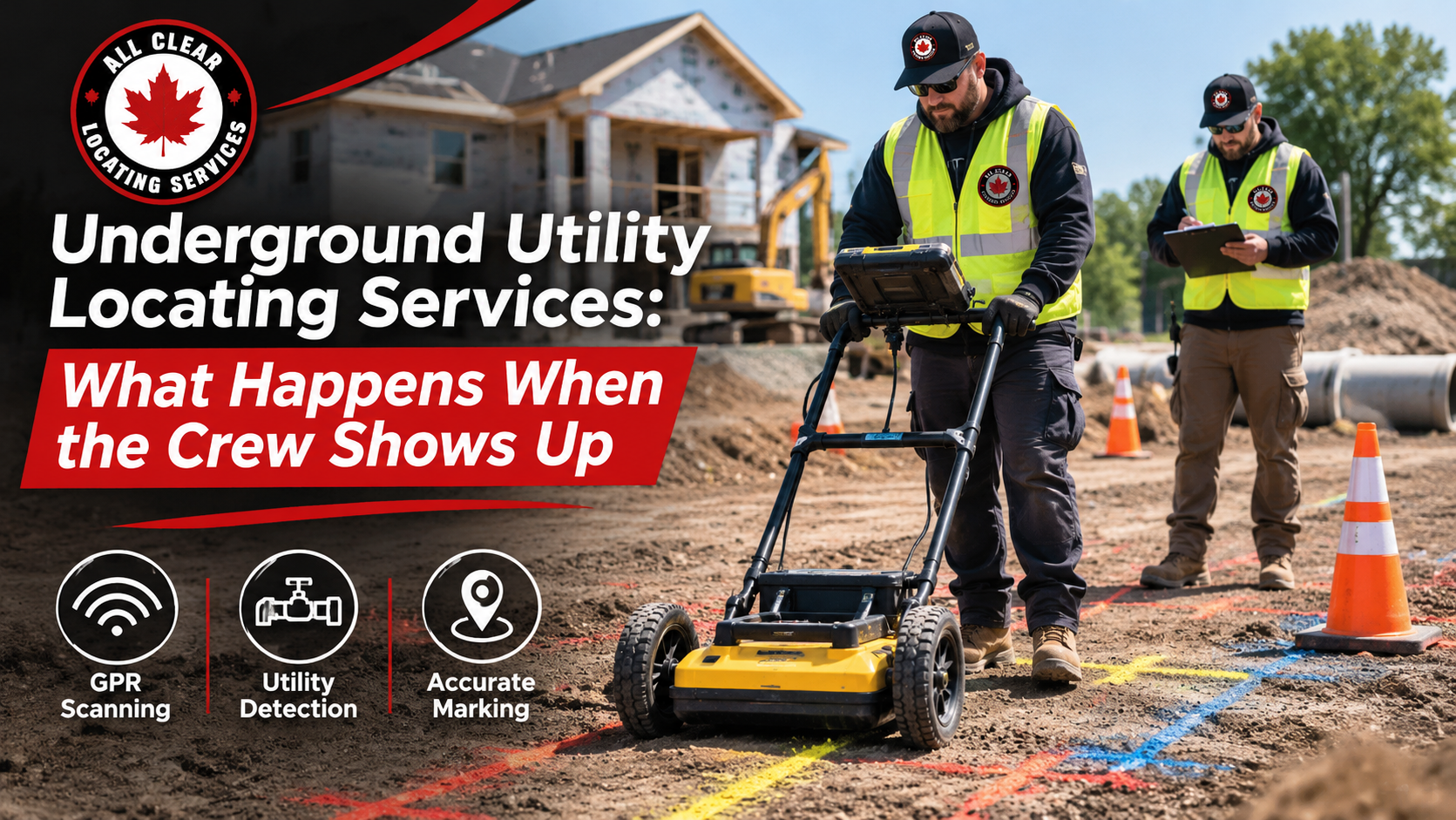
Most people who book underground utility locating services have never watched a locate happen. They know someone will arrive with a cart and a paint can, and later there will be colored lines across the lawn. The middle part is where the skill is, so here is what actually goes on.
Step one: the walk-through
Before any equipment comes out, the technician walks the site and talks to you. Where do the meters sit? Where is the dig going? Has anything been added since the house was built? Visible clues like cleanouts, valve boxes, and patched pavement often point to buried lines faster than a screen does.
Step two: electromagnetic detection
The workhorse of the industry is a transmitter and receiver pair. There are two ways to use it.
- Direct connection. The transmitter clips onto an exposed pipe, a tracer wire, or a meter. The signal travels along the line and the receiver follows it. This gives the cleanest result.
- Induction. When there is nothing to clip onto, the transmitter sends a signal through the ground and nearby metal lines pick it up. It is quicker but less precise, so the technician cross-checks it.
Passive scans for power and radio signals also help spot live electrical lines nobody told you about.
Step three: ground penetrating radar
Electromagnetic tools need something conductive to follow. Plastic water lines, clay sewer pipe, and concrete conduits do not carry a signal. Ground penetrating radar sends pulses into the soil and records what bounces back. Experienced operators read the pattern of reflections to spot pipes, tanks, and voids. Radar works best in dry, sandy soil and struggles in wet clay, so it is one tool among several, not a magic answer.
Step four: marking and verifying
Lines get painted or flagged using the national color code. Red marks electric, yellow marks gas or oil, orange marks communications, blue marks drinking water, green marks sewer, and purple marks irrigation or reclaimed water. A competent crew checks each mark against a second reading before packing up, because a mark that is off by a foot can still lead to a cut line.
What the marks do not tell you
Marks show horizontal position and an approximate depth. They do not guarantee a line is exactly where the paint sits. That is why safe digging practice calls for hand digging or vacuum excavation inside the tolerance zone next to a marked line. A good technician will explain this at the end of the visit.
Underground utility locator near me: what to check
When you search for an underground utility locator near me, look for a company that handles both public-side coordination and private-side work. Ask about:
- The equipment used on residential versus commercial jobs
- How findings are recorded and delivered
- Insurance and licensing
- Turnaround time, especially if your project has a hard start date
A locating service near me that also offers GPS documentation will save you time on later phases, since the data can be reused instead of repeated.
Frequently asked questions
How accurate are the marks? That depends on soil, depth, and what the line is made of. Our crews verify each mark and report anything uncertain.
Will paint damage my lawn? The paint used for locating is temporary and fades with weather and mowing. Flags are removed once the job is complete.
Can you locate abandoned lines? Sometimes. Abandoned metal lines can often still be traced. Dead, disconnected plastic lines are much harder.
Schedule an underground locate in the Twin Cities
Our underground utility locating services support excavation, trenching, and site development across Maple Grove, Minneapolis, and nearby suburbs. Request a quote or call (612) 810-9766 to pick a date.