
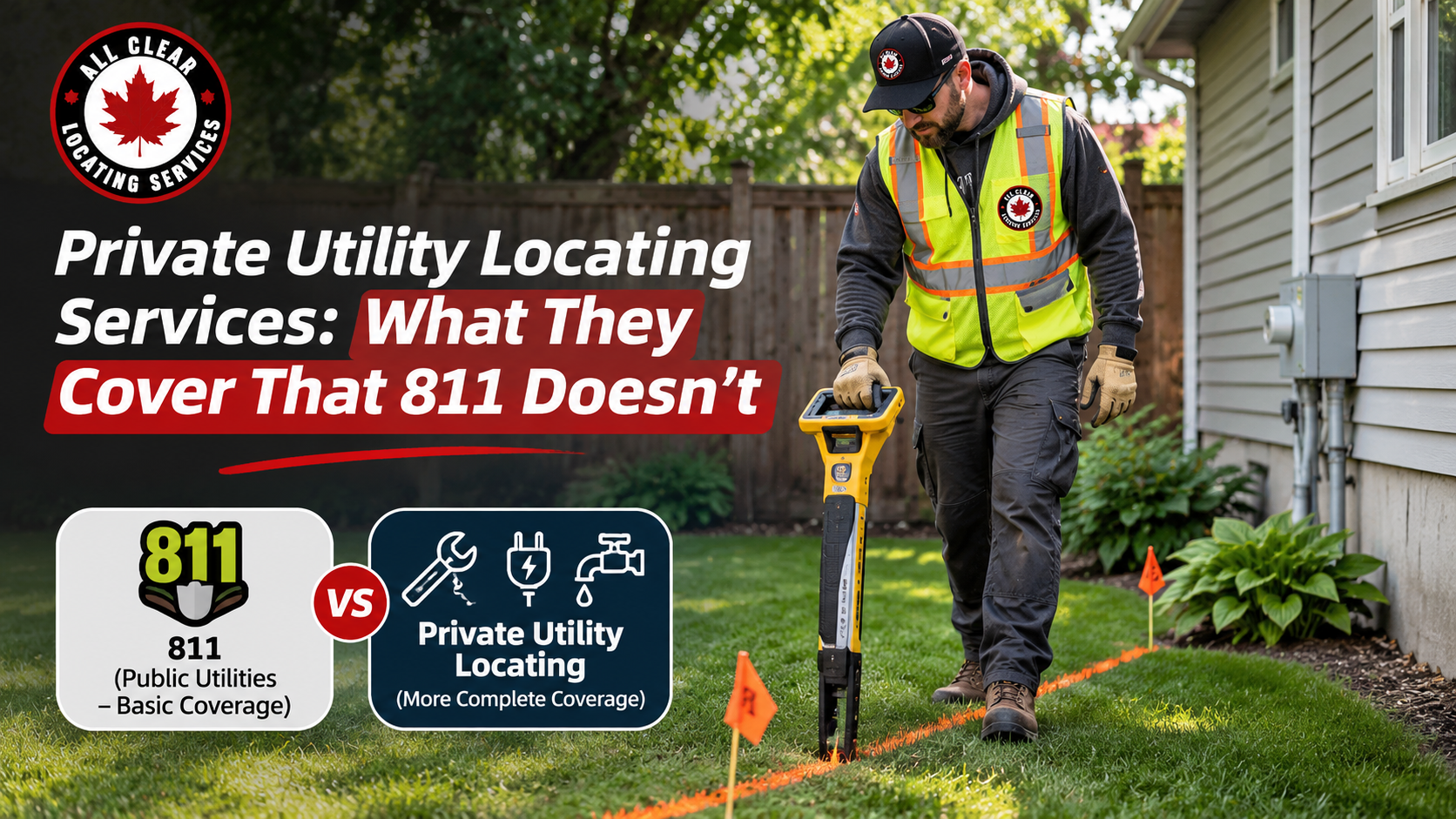
Private utility locating services exist because of one gap in the system. The public one-call program marks lines owned by utility companies. It does not mark the lines that a property owner, a builder, or a past contractor installed on the lot. Those are the lines most people forget about, and they are the ones that tend to get hit.
What counts as a private utility
A private utility is any buried line or structure that the property owner is responsible for. In practice that usually means:
- Electrical runs to detached garages, sheds, barns, and hot tubs
- Propane and natural gas lines downstream of the meter
- Irrigation mains, zone valves, and sprinkler heads
- Water service lines on the owner’s side
- Septic tanks, drain fields, and sewer laterals
- Low voltage landscape lighting and invisible pet fence wire
- Data, camera, and communication cable added after the original build
None of these show up in a public record. Many were put in by a previous owner, and nobody wrote down where.
How private utility locating works
The technician starts with the visible clues: meters, cleanouts, junction boxes, valve covers, and the shape of the lot. Then comes electromagnetic detection. Where a line is metal or has a tracer wire, we connect a transmitter and follow the signal. Where it is not, we use induction, radar, or a sonde pushed through the pipe.
Every line gets marked, and we verify marks against a second reading before leaving. On projects that need a permanent record, our RTK GPS utility mapping captures each path as coordinates you can keep.
When you need private utility locating
The short answer is any time you are digging deeper than a garden trowel can reach. Common jobs include:
- Installing a fence or setting posts
- Building a deck, pergola, or retaining wall
- Putting in a pool or a patio
- Trenching for a new service or a drainage line
- Planting large trees
- Buying a property and wanting to know what is underneath
Contractors also request private locates on commercial lots, where years of tenant changes leave behind lines that no current plan shows.
Why the 811 call is not enough
Calling 811 is the right first step and in Minnesota it is the law. We recommend you do both. The public locate protects the utility’s equipment, and a private locate protects everything else. If you want the details on where that line is drawn, we cover it in our post on 811 utility lines.
How to compare private utility locating services near me
When you look at private utility locating services near me, compare more than price. Ask whether the company is insured, what equipment it uses, whether it documents findings, and how soon it can be on site. A low quote with no report and no insurance usually costs more in the end.
Frequently asked questions
Can a private locator find plastic pipe? Yes, in most cases. It takes a different method than metal pipe, such as a tracer wire, a sonde, or radar, and results depend on soil conditions.
Do I still need to call 811? Yes. Minnesota law requires it before most excavation, and it covers the utility-owned lines that we do not mark.
Can you tell me how deep a line is? We can give an estimate. Depth readings are approximate, so always hand-dig or vacuum-excavate near a marked line.
Talk to a private locating team in Maple Grove
Our private utility locating services cover homes, businesses, and municipal sites across the Twin Cities. Get a free quote and we will confirm a date inside your project window.